
Advice from multi-station operators on how to minimize intermodulation and RFI.
Conrad Trautmann, N2YCH ARRL Technical Editor, Keith Elliott W6KME Contributor and Member VCARC and CVARC
ARRL Field Day in California
Now, let’s apply these principles to your club’s Field Day operations, or to any multi-station portable operation.
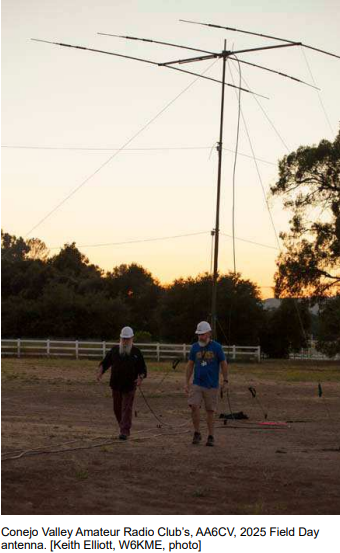
Keith Elliott, W6KME, from the Conejo Valley Amateur Radio Club, AA6CV, in southern California has successfully run Field Day for his club for 3 years using 23 stations that are able to operate at the same time.
Antennas
Keith maximizes use of the space allowed in the Field Day rules and selects antennas that will provide maximum isolation between one another, providing good signals aiming north/northwest. By lining up the three identical HF antenna arrays end to end, the nulls at each end of the dipoles aim at each other, minimizing the amount of RF getting into the adjacent array. They use 36-foot military crank-up towers with a Hy-Gain tri-band antenna at the top of three towers for 20, 15, and 10 meters; an 80-meter homebrew dipole at 31 feet, and a 40-meter dipole at 27 feet. The dipoles are all horizontal and parallel to the ground, not inverted-V antennas. There is an RF choke — a 22- inch mix-31 toroid — at the feed point of each antenna.
Transmission Line and Filters
Keith uses RG-214 shielded coaxial cable for all RF cable runs. The Conejo Valley Amateur Radio Club uses Dunestar triplexers connected to tri-band antennas so all three bands can be used simultaneously, while isolating each band and radio from the others. Another run of RG-214 coaxial cable goes from the triplexers to each of the radio positions, where a VA6AM band-pass filter is installed at each transmitter for the single band it will operate on. The transceivers cannot be tuned to other bands — they’re dedicated to the band they’re assigned to. Changing frequency is prohibited to protect the filters and the triplexers. Finally, another RF choke like the one at the antenna feed point is installed between the radio and the bandpass filter.
Transceivers
Good transceivers are key. Keith said he tends to put the worst performers on the low bands, like 160 or 80 meters, which, relatively speaking, don’t get nearly as much use as the 40- and 20-meter bands. He reserves the better-quality transceivers for CW operators because they need the best filtering to operate. Keith avoids putting transceivers with poor automatic level control performance on digital modes. Keith says that when Field Day kicks off in California at 11 AM local time, each one of their 23 stations is live and on the air. He’s proud to say that everyone can operate, interference-free. Good Operator Hygiene The final message Keith wanted everyone to know is that training people on how to use the equipment ahead of time is a key factor in helping to keep their Field Day interference-free. Not overmodulating FT8, not switching bands and burning up a band-pass filter, and not removing the filters or chokes from the systems all contribute to a successful, RFI-free event. It’s understood that filters and chokes can cause a bit of insertion loss, but that’s a necessary compromise to have that many stations operating within the 1,000-foot radius. Spend time with your operators to train them on how to use the equipment properly.
In Conclusion
Wrapping up, the common messages and takeaways from successful multi-station operations include: • Having an RF-quiet location • Using dedicated bands, antennas, and radios • Installing high-power band-pass filters for each band on the radio • Having transceivers with good filtering and adjacent channel rejection • Installing dipole antennas in-line to minimize pattern overlap • Having a quiet power source and ac-line filtering • Using quality, shielded-RF ac and computer cables • Setting up good grounding and bonding • Having 1:1 baluns at radio and antenna feed points • Training operators I look forward to seeing you all on the air during this year’s ARRL Field Day on June 27 – 28!
