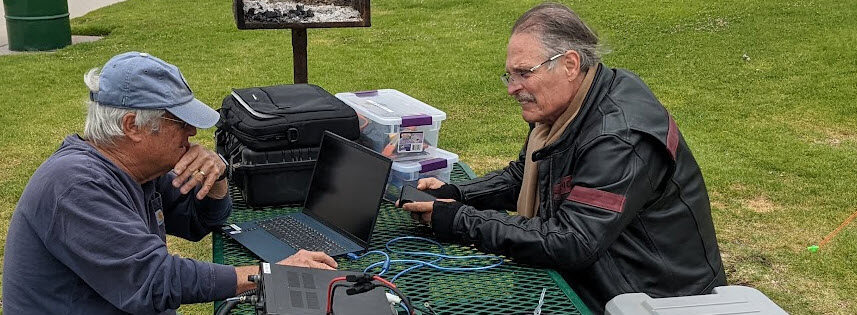
During the recent Walk for Kids event, the topic of handheld radios (HTs) came up. Choosing the right HT is crucial for effective emergency communications, and it largely depends on your personal preferences, budget, and intended use. Here are some key points to consider:
1. Usage
First, think about how you plan to use your radio. If you primarily operate on 2m/70cm repeaters and occasionally use simplex for local events like Walk for Kids, a basic dual-band HT might be all you need.
Analog Radios
Analog radios come in a variety of price ranges:
- Budget-Friendly Options: There are affordable Chinese-made radios like Baofeng and its clones. These are good for beginners but may not be suitable for use near hospitals due to unwanted harmonics. A good alternative is the TYT-8000D or E at around $80, which has a cleaner signal.
- Mid-Range Options ($100 – $200): Brands like Yaesu, Icom, and Anytone offer reliable mid-range radios. Examples include the Yaesu FT-60R, FT-70DR, VX-6R, Icom IC-T10, and Anytone AT-D168UV. Some of these radios can use AA batteries, which is a useful feature for emergencies.
- Premium Options: Premium radios offer additional features like digital voice modes, APRS, GPS, and waterfall displays. However, these features may not be necessary for basic emergency communications.

Digital Modes
LAXNORTHEAST primarily uses analog modes to ensure inclusivity and reach a broader audience. If you’re interested in digital modes like DMR, Fusion, or D-Star, make sure there are compatible repeaters in your area. Most digital radios also support analog 2m/70cm operation.
2. Programming Software
There are two main choices for programming software:
- CHIRP: Free, open-source, and supports a wide range of radios. You’ll need a programming cable unless your radio has a USB port.
- RT Systems: User-friendly and spreadsheet-based, but each software package is specific to one type of radio. The software costs around $25, and bundles with programming cables are available for $40 – $50. RT Systems programming cables can usually be used with CHIRP, too.
For HTs CHIRP is an excellent choice.
RT System shines with HF rigs that can be more complex.
3. Programming Cable
Budget around $25 – $30 for a good quality programming cable. BlueMAX49ers and ValleyEnterprises are reliable sources for cables that use FTDI chips, which are more reliable than some cheaper alternatives.
Radios On Sale as of May 4, 2025
- Yaesu FT-60R: A long-time favorite for emergency communicators due to its durability, decent battery life, and access to weather bands. It can also use 6 AA batteries with the FBA-25 battery adapter.
- Yaesu FT-70DR: A good radio but the shorter battery life makes it impractical for extended field use. It’s best used when you have access to a charger.
- Yaesu VX-6R: Excellent for those who regularly use 220MHz. It also has an AA battery pack option.
- Yaesu FT-65R and FT-4R: Nice radios but not on sale as of this writing (May 4, 2025). They were designed to compete with Chinese radios, so their build quality may not match the FT-60R or VX-6R.
Sales are happening all the time – especially around hamventions and the holiday season. Different manufacturers time their sales differently, too, so keep checking for your preferred HT at regular intervals.
Candy Stores
GigaParts https://www.gigaparts.com/yaesu
DX Engineering https://www.dxengineering.com/
Ham Radio Outlet https://www.hamradio.com/
R&L Electronics https://www2.randl.com/
1. I would advise a new user to purchase the optional AA battery case for every HT as a mandatory accessory. When doing your event, always take two sets of AA’s at a minimum. Put in fresh ones before the event, then carry the spares in your pocket. The most common radio failures are rechargeable batteries. They are invariably less than fully charged and older ones may not last through your event. Yes, do take your rechargeable batteries, but remember that trying to charge them the morning of the event will not be sufficient. AA’s are always ready to go and may even be available from another ham in a pinch.
2. When working at a public event, always use your HT’s high-power setting, unless you are certain there is no need for it. Do not wait for control to tell you your signal is weak or noisy.
3. Buy the optional earpiece and / or speaker mic. You will miss calls with the radio just sitting on your belt.
4. Buy an optional antenna and replace the ‘rubber ducky” that came with the radio.
5. Keep your transmissions short and concise. Listen, listen, listen. Friendly commentary and chatter should be avoided.
73, John Minger, AC6VV
